
I recently found a Reader's Digest collection at my parent's home. It was too good not to share. So Wednesday, December 8, 2021, be sure to tune in for "A Festival of Light Classical Music." From 7 am to 9 am I'll be playing sections from these LPs and having some fun.
You might not know the names of all these pieces, but I guarantee they'll sound familiar!
What we can't share on-air (but I can here) is the packaging. Everything about this set makes the buyer feel cultured and sophisticated. -- even if they knew nothing about classical music.

There's an introduction by Arthur Fiedler (the one conductor non-classical listeners might recognize). No Fiedler recordings appear in this set, BTW.
Fiedler's message is both inviting to the novice and loaded with cultural baggage.
"Every piece here selected is music of quality, music composed with passion and enthusiasm, music written by great composers. It is therefore light music which one can take seriously."
He does end with some practical advice.
"How can you best listen to this Festival? Any way that you enjoy it is the best way for you... No special knowledge, no magic formula, no 'open sesame' are required; all one needs in an open heart."

“An Introduction by Arthur Fiedler” Transcript:
“Rossini, a remarkable genius and a remarkable wit, once said that he knew only two kinds of music: good music and boring music. All of this music belongs to the first category. It is the kind of music which you will enjoy the first time you hear it — and the hundredth.
It is “light.” Yet every piece here selected is music of quality, music composed with passion and enthusiasm, music written by great composers. It is therefore light music which one can take seriously. Many of the compositions are more than a century old and some, such as the beautiful selections by Mozart in REcord 10, approach the two-century mark. They have survived changing fashions, a changed social structure, changed manners, changed customs. And they shine today with as serene a light as when they were first heard.
Quite a few of the compositions are light in the sense that they are humorous. Others are sad, nostalgic, gentle. Still others are rousing, ardent, exciting. A wide range of feeling and emotion is covered. That range can perhaps be best exemplified by noting that the album contains a fluffy little polka by Johann Strauss (Record 5, Side 1) as well as Wagner’s heaven-storming and fiery tale of his tragic hero, Siegfried’s Rhine Journey (Record 9, Side 2).
What prompted composers to write light music? Variouscircumstances. Tchaikovsky wrote the Nutcracker Suite because he was fond of children. He composed the 1812 Overture as an expression of patriotism. Patriotism prompted Smetana to write a whole cycle of tone poems called My Country, of which the loveliest, his tribute to the river Moldau, is here included. Berlioz wrote his famous Rakóczy March as part of his huge composition, the Damnation of Faust, probably because he, a superb orchestrator, wanted to show off the resources of the orchestra. (You will hear it here presented with all the resources of modern recording techniques.) Verdi composed the Grand March from Aïda because the opera was commissioned to celebrate an important and world-wise event: the opening of the Suez Canal.
How can you best listen to this Festival, one which contains 70 pieces by 42 composers of nine nationalities? Any way that you enjoy it most is the best way for you. However you listen, we hope that the album will refresh and deepen your enjoyment of and friendship with good music. This kind of music belongs to everybody, to the initiate as well as to those who can’t tell a fugue from a fandango. No special knowledge, no magic formula, no “open sesame” are required; all one needs is an open heart.
Arthur Fiedler [signature], Conductor of Boston Symphony Pops Concerts.”
The set includes an impressive booklet that informative and accessible liner notes.

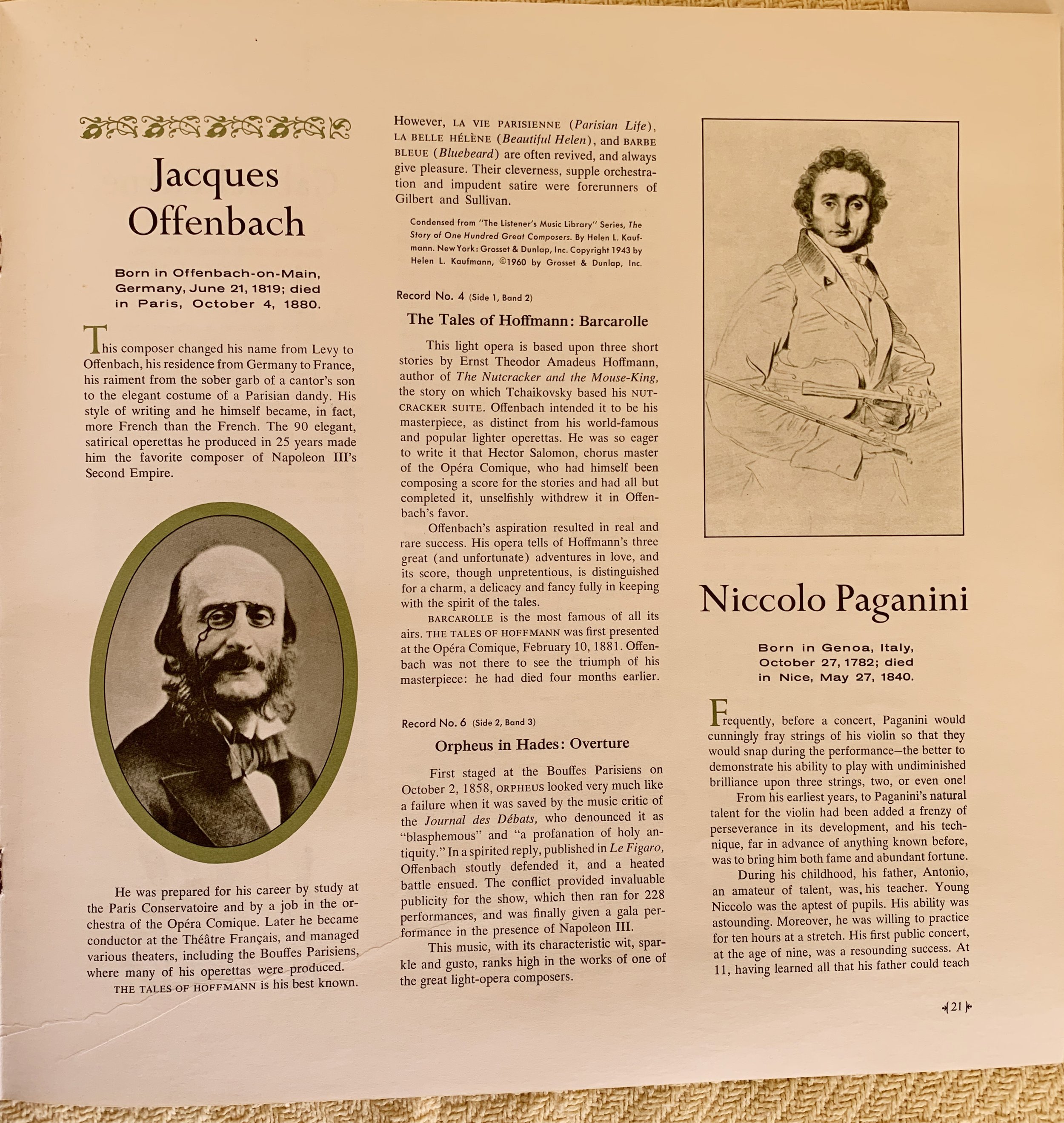
“Adventures in Light Classical Music” pg. 21 Transcript:
“Jacques Offenbach
Born in Offenbach-on-Main, Germany, June 21, 1819; died in Paris, October 4, 1880.
This composer changed his name from Levy to Offenbach, his residence from Germany to France, his raiment from the sober garb of a cantor's son to the elegant costume of a Parisian dandy. His style of writing and he himself became, in fact, more French than the French. The 90 elegant, satirical operettas he produced in 25 years made him the favorite composer of Napoleon III's Second Empire.
(Portrait of Jacques Offenbach)
He was prepared for his career by study at the Paris Conservatoire and by a job in the orchestra of the Opéra Comique. Later he became conductor at the Théâtre Français, and managed various theaters, including the Bouffes Parisiens, where many of his operettas were produced.
The Tales of Hoffman is his best known. However, La Vie Parisienne (Parisian Life), La Belle Hélène (Beautiful Helen), and Barbe Bleue (Bluebeard) are often revived, and always give pleasure. Their cleverness, supple orchestration and impudent satire were forerunners of Gilbert and Sullivan.
Condensed from "The Listener's Music Library" Series, The Story of One Hundred Great Composers. By Helen L. Kaufmann. New York: Grosset & Dunlap, Inc. Copyright 1943 by Helen L. Kaufmann, 1960 by Grosset & Dunlap, Inc.
Record No. 4 (Side 1, Band 2)
The Tales of Hoffmann: Barcarolle
This light opera is based upon three short stories by Ernst Theodor Amadeus Hoffmann, author of The Nutcracker and the Mouse-King, the story on which Tchaikovsky based his Nutcracker Suite. Offenbach intended it to be his masterpiece, as distinct from his world-famous and popular lighter operettas. He was so eager to write it that Hector Salomon, chorus master of the Opéra Comique, who had himself been composing a score for the stories and had all but completed it, unselfishly withdrew it in Offen- bach's favor.
Offenbach's aspiration resulted in real and rare success. His opera tells of Hoffmann's three great (and unfortunate) adventures in love, and its score, though unpretentious, is distinguished for a charm, a delicacy and fancy fully in keeping with the spirit of the tales.
Barcarolle is the most famous of all its airs. The Tales of Hoffman was first presented at the Opéra Comique, February 10, 1881. Offenbach was not there to see the triumph of his masterpiece: he had died four months earlier.
Record No. 6 (Side 2, Band 3)
Orpheus in Hades: Overture
First staged at the Bouffes Parisiens on October 2, 1858, Orpheus looked very much like a failure when it was saved by the music critic of the Journal des Débats, who denounced it as "blasphemous" and "a profanation of holy antiquity." In a spirited reply, published in Le Figaro, Offenbach stoutly defended it, and a heated battle ensued. The conflict provided invaluable publicity for the show, which then ran for 228 performances, and was finally given a gala performance in the presence of Napoleon III.
This music, with its characteristic wit, sparkle and gusto, ranks high in the works of one of the great light-opera composers.
Niccolo Paganini
Born in Genoa, Italy, October 27, 1782; died in Nice, May 27, 1840.
Frequently, before a concert, Paganini would cunningly fray strings of his violin so that they would snap during the performance-the better to demonstrate his ability to play with undiminished brilliance upon three strings, two, or even one!
From his earliest years, to Paganini's natural talent for the violin had been added a frenzy of perseverance in its development, and his technique, far in advance of anything known before, was to bring him both fame and abundant fortune.
During his childhood, his father, Antonio, an amateur of talent, was, his teacher. Young Niccolo was the aptest of pupils. His ability was astounding. Moreover, he was willing to practice for ten hours at a stretch. His first public concert, at the age of nine, was a resounding success. At 11, having learned all that his father could teach…”
It also included a guarantee of quality and satisfaction. it assures the purchaser that, among other things, "each set of records is completely new." Well, that's a relief. I wouldn't want to pay good money for some second-hand vinyl!

“RCA/Reader's Digest Guarantee of Quality and Satisfaction” Transcript:
“This is your RCA/Reader’s Digest Guarantee of Quality and Satisfaction.
These are new "Cyclophonic Miracle Sound"® records, created especially and newly recorded for Reader's Digest by the Custom Record Department of the Radio Corporation of America.
The very latest advances in the art of audio recording and high fidelity sound reproduction have been employed in their recording and manufacturing.
They feature the clarity and brilliance of full-frequency recording, plus uniform response across the entire playing surface.
The finest materials (including 100% pure vinyl compound) and craftsmanship were used throughout the manufacturing process.
Each set of records is completely new, and has been shipped directly from the RCA factory to you. Before leaving the factory each record has been subjected to the most modern inspection and testing techniques.
In the event of defect in manufacture, any record will be exchanged free of charge if returned within fifteen days.
For best reproduction and longest life, they should be played with a quality needle that is in good condition.
Margaret Adams [Signature], The Reader’s Digest Association, Inc. High Fidelity Record Division.
Pleasantville, New York”
There's a handy guide for those new to long-playing albums. It recommends using a diamond needle, as opposed to a sapphire needle or (heavens!) a metal needle. "Most lovers of good music consider [the diamond needle] well worth the extra cost."
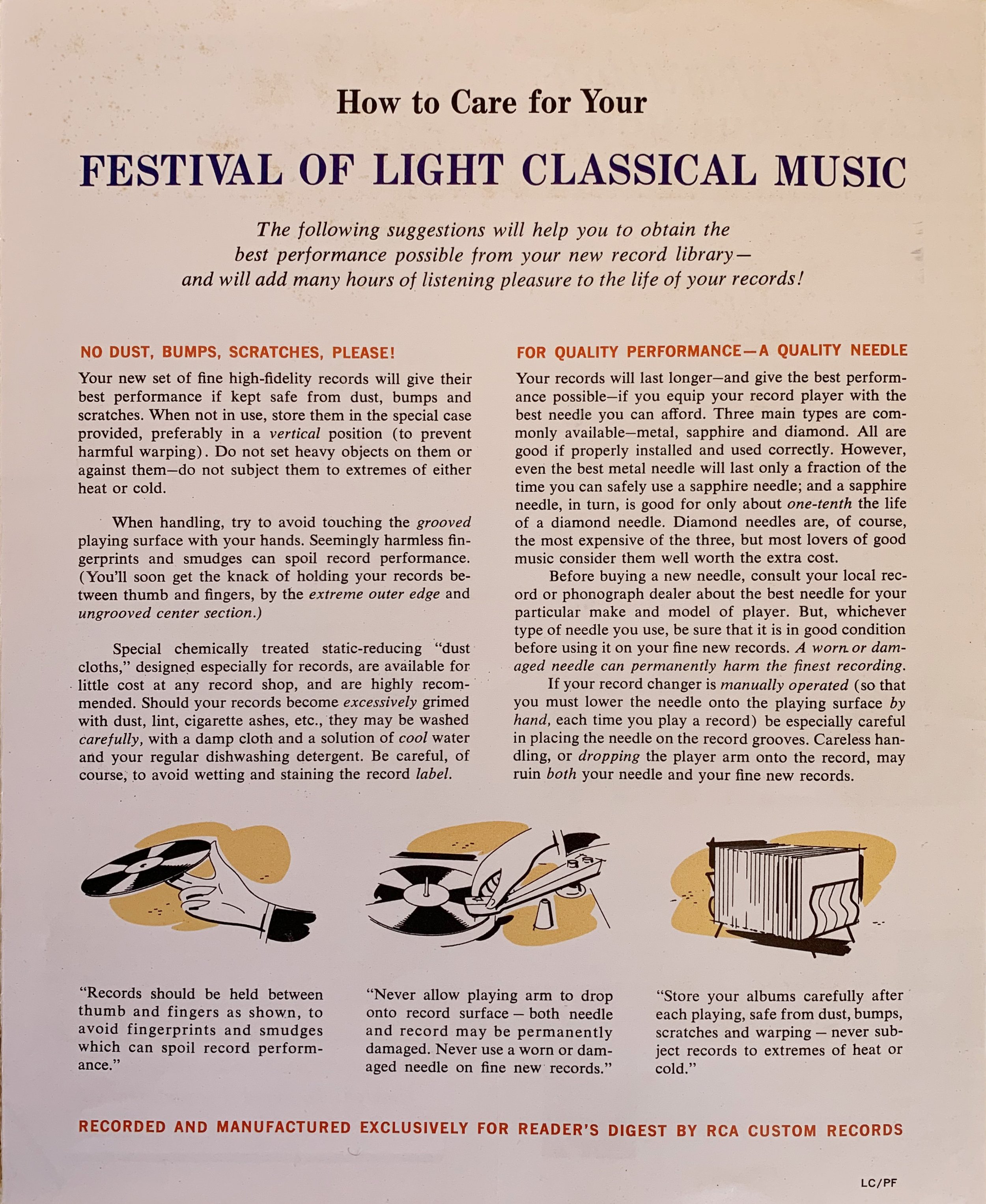
“How To Care for Your Festival of Light Classical Music” Transcript:
“The following suggestions will help you to obtain the best performance possible from your new record library — and will add many hours of listening pleasure to the life of your records!
No Dust, Bumps, Scratches, Please!
Your new set of fine high-fidelity records will give their best performance if kept safe from dust, bumps and scratches. When not in use, store them in the special case provided, preferably in a vertical position (to prevent harmful warping). Do not set heavy objects on them or against them — do not subject them to extremes of either heat or cold.
When handling, try to avoid touching the grooved playing surface with your hands. Seemingly harmless fingerprints and smudges can spoil record performance. (You'll soon get the knack of holding your records between thumb and fingers, by the extreme outer edge and ungrooved center section.)
Special chemically treated static-reducing "dust cloths," designed especially for records, are available for little cost at any record shop, and are highly recommended. Should your records become excessively grimed with dust, lint, cigarette ashes, etc., they may be washed carefully, with a damp cloth and a solution of cool water and your regular dishwashing detergent. Be careful, of course, to avoid wetting and staining the record label.
For Quality Performance, a Quality Needle
Your records will last longer-and give the best perform- ance possible-if you equip your record player with the best needle you can afford. Three main types are commonly available—metal, sapphire and diamond. All are good if properly installed and used correctly. However, even the best metal needle will last only a fraction of the time you can safely use a sapphire needle; and a sapphire needle, in turn, is good for only about one-tenth the life of a diamond needle. Diamond needles are, of course, the most expensive of the three, but most lovers of good music consider them well worth the extra cost.
Before buying a new needle, consult your local record or phonograph dealer about the best needle for your particular make and model of player. But, whichever type of needle you use, be sure that it is in good condition before using it on your fine new records. A worn or damaged needle can permanently harm the finest recording.
If your record changer is manually operated (so that you must lower the needle onto the playing surface by hand, each time you play a record) be especially careful in placing the needle on the record grooves. Careless handling, or dropping the player arm onto the record, may ruin both your needle and your fine new records.
"Records should be held between thumb and fingers as shown, to avoid fingerprints and smudges which can spoil record performance."
"Never allow playing arm to drop onto record surface - both needle and record may be permanently damaged. Never use a worn or damaged needle on fine new records."
"Store your albums carefully after each playing, safe from dust, bumps, scratches and warping - never subject records to extremes of heat or cold."
Recorded and Manufactured Exclusively for Reader’s Digest by RCA Custom Records.”
The set also has a promo sheet with detachable postcard order forms to share with friends. It features some celebrity endorsements from notables like Bennet Cerf and Arlene Francis. Although I do wonder why they put the word listeners in quotes.

“A Life-Long Source of Pleasure and Inspiration” Transcript:
An album you can be proud to own and display in your home
Brought to you by RCA and Reader's Digest at a fraction of the cost you might expect to pay
We hope that as you open your Festival of Light Classical Music album and prepare to "sample" its delightful musical contents, you will note these exclusive "connoisseur" features, brought to you exclusively by the editors of Reader's Digest and the Custom Records Staff of RCA:
All Brand New "Cyclophonic" Miracle Sound Recordings -You Might Expect to Pay Up to $59.76
Every record in this beautiful new album is brand-new, never-before-released-recorded exclusively for FESTIVAL OF LIGHT CLASSICAL MUSIC in thrilling "Cyclophonic" Miracle Sound. This means that your records represent the very latest developments in modern high-fidelity recording, pioneered by RCA's world famous "sound engineers." From each painstaking recording session, right down to the creation of the precious "master" discs, RCA experts were on hand to ensure that the fine vinyl records you now possess measure up to the highest standards.
As a result, your records feature a brilliance of color and tone that you usually find only in far more expensive recordings. The sound that flows into your living room possesses all the electrifying depth and clarity of a "live" performance, right in the concert hall!
Ordinarily, you might expect to pay as much as $4.98 each for records of this same fine quality- anywhere from $35.76 up to $59.76 for a 12-record set such as this. But because you are a Digest subscriber, you get the entire album-packed in a handsome lifetime presentation case - for only a fraction of the usual cost!
To Match Fine Music-Some of the Finest Orchestras and Conductors Performing In Europe Today
To perform this lovely music, RCA engaged some of the finest orchestras and soloists performing in Europe today- and six internationally respected conductors! The names on your record labels read like a "Who's Who" of musical talent: Sir Adrian Boult and Alexander Gibson with the New Symphony Orchestra of London; René Leibowitz and the Orchestre de la Société des Concerts Symphonique des Paris; Josef Leo Gruber and Victor Desarzens with the Vienna State Opera Orchestra; Massimo Freccia and the Orchestra Filarmonica di Roma- each supremely capable of presenting a certain portion of the glittering light classics repertoire!
Because these are true "connoisseur" recordings-comparable to the finest and most expensive records made - RCA determined from the start that every performance should be flawlessly perfect. Full orchestras were used throughout-each masterpiece was performed as the composer himself had originally written it. In many cases, the original instruments were used, specified by the composer in his own notebooks. The result is a virtual "collector's library" of memorable performances, far exceeding anything attempted in recent years.
Also Included: "Adventures In Light Classical Music"- a Helpful Guide to the Composers and their Works An important part of your Festival of Light Classical Music album is the richly illustrated 40-page "appreciation guide," Adventures in Light Classical Music. This attractive booklet is brimful of interesting facts and anecdotes about the composers represented in your album. Did you know, for example, that Mozart was an internationally acclaimed concert pianist and violinist-at the age of seven! Or that by the time he was 15 he had already composed 14 symphonies and six short operas! Adventures in Light Classical Music contains scores of interesting facts and anecdotes like this, to take you "behind the orchestra" to a full appreciation of the composer and the music itself.
Few possessions that you could obtain for yourself and your family offer such permanent pleasure as this fine "library" of the best of the delightful light classics. Not only for now, but for years to come, you will find this album an unending source of rare and warm-hearted musical enjoyment. We think you will agree with Arlene Francis, who calls this album a "memorable achievement."
Good Listening!...
What Some Favorite “Listeners” Say
BENNETT CERF, Famous Author, Publisher, Columnist and Television Personality, writes: "There are certain basic books and basic recordings of great music that belong in the home of every American. Publishers have made these basic books readily available to everyone. Now I am delighted to see Reader's Digest recordings that do the same job for music. They are fine, com- pact packages and the accompanying "Appreciation Guides", with their fascinating information about the composers and their works, are an additional blessing. Congratulations!"
ARLENE FRANCIS, Popular Television Star and Author of "That Certain Something: The Secret of Charm", says: "You have added immeasurably to my listening pleasure with these new sets of records that easily equal in sound and quality the most expensive al- bums I own. They are a memorable achievement for Reader's Digest and RCA. Never before has so much been available for so little!"
WILFRID PELLETIER, Distinguished Conductor of the Metropolitan Opera Orchestra and the Montreal Symphony, comments: "Having listened to the exciting new record albums especially recorded for Reader's Digest, I know they will bring many hours of enjoyment to listeners. The performances, the quality of sound and the selection of compositions all are excellent. Together, they make these albums a 'must' for every home where good music is valued among the fine and important things of life".
SIGMUND SPAETH, Noted Music Critic, Columnist, Radio Personality and Author of "Fifty Years With Music", writes: "The new Reader's Digest albums seem to me a remarkable value. The selection of music is excellent and the performances and quality of recording are truly commendable throughout. Music lovers should not over- look this rare opportunity to acquire, at moderate cost, a basic library of the world's great music".
"A Festival of Light Classical Music" was more than a set of records. It was an easy way to add sophistication to your life, and impress your friends!